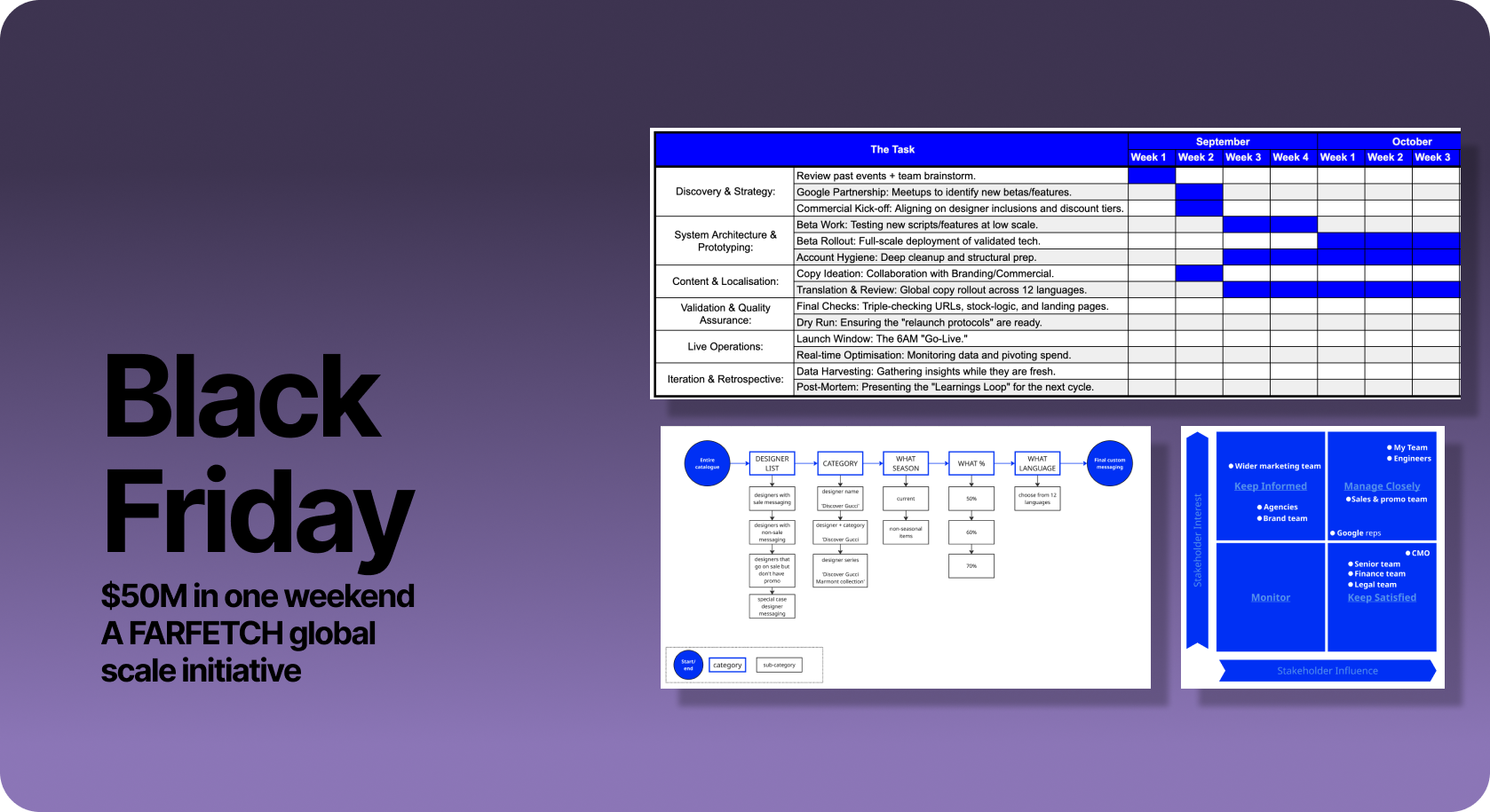
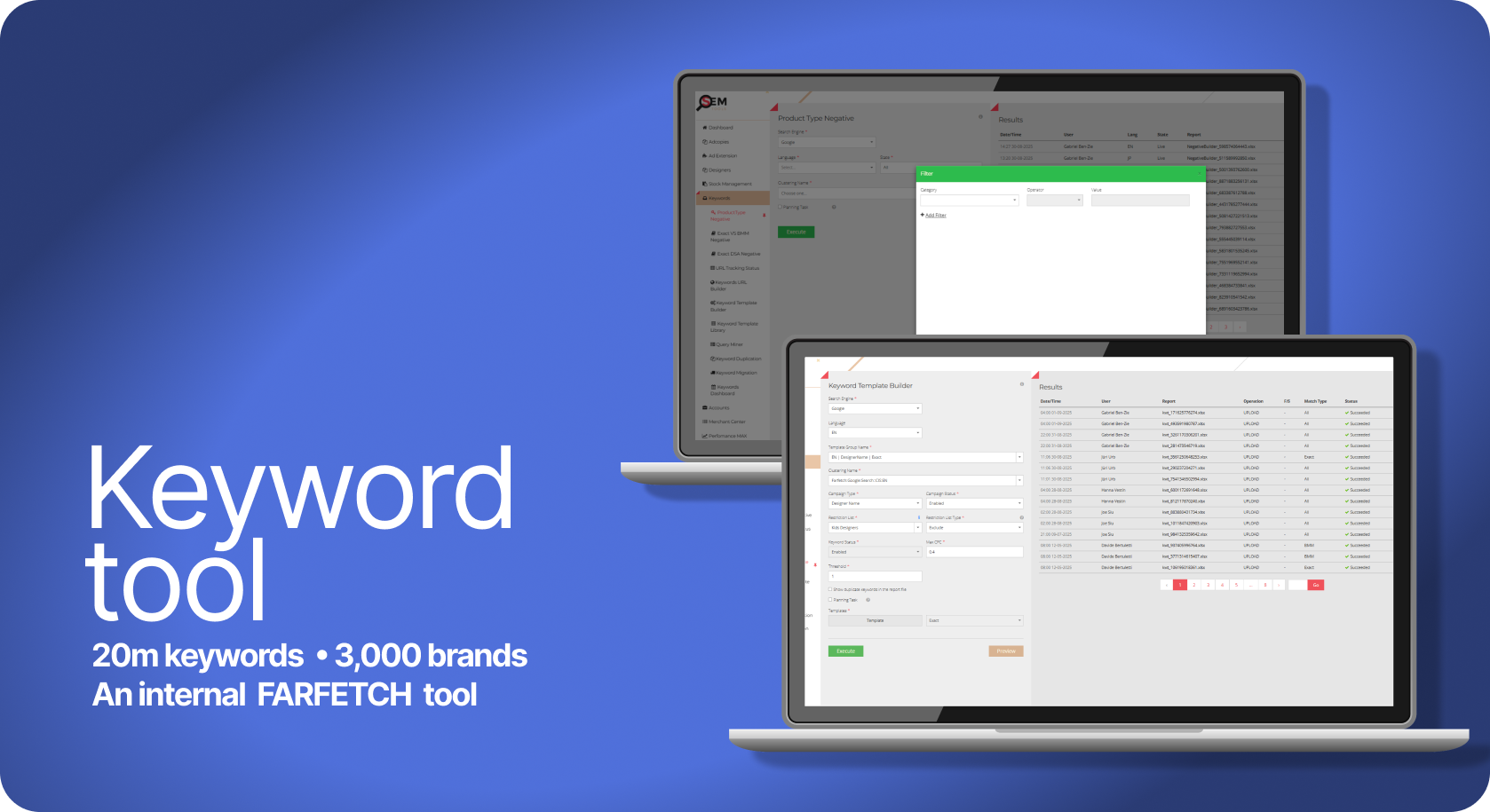
Overview
The Client
Farfetch is an online luxury retailer operating in 12 languages with an expansive catalogue of over one million items from 3,000 designers
My Role
UI, UX, Project
Management & digital marketing.
The Challenge
Managing five million global ad variations required absolute precision. To ensure every ad met strict search engine requirements and linked to the correct landing pages, I led the automation of our internal workflows—eliminating manual error and maintaining brand integrity at a massive scale.
Context & Research
The Context As a global business operating across 12 languages, I identified the need for a centralised tool to manage our international output across multiple platforms. The design needed to be universal and scalable, ensuring a seamless transition during team changes. Most importantly, it had to strictly adhere to search engine guidelines while automating complex manual workflows to simplify the core team’s daily operations. This required:
Commercial Relevance: Developing a system that generates brand-specific, keyword-rich ad copy tailored to specific landing pages, ensuring maximum performance across Google, Bing, Yahoo JP, Naver, and Baidu.
Operational Efficiency: Replacing inadequate off-the-shelf software with a custom tool that manages character limits, language accuracy, and trademark compliance—targeting a 90% reduction in ad disapproval rates.
Cross-Functional Alignment: I bridged the knowledge gap by educating the engineering team on the complexities of Paid Marketing, ensuring the technical build was fully aligned with our specific marketing requirements.
Problem Statement
Ad management was a manual, fragmented process with no oversight of landing page accuracy or brand coverage. Without a customisable solution, reacting to short-term promotions was slow and error-prone. I recognised that we needed an automated tool to streamline ad creation and ensure strict adherence to brand guidelines and media requirements.
The User Flow maps the tool’s logic, starting with complex brand segmentation across 3,000 designers—categorised by sale, flash promo, or full-price status. From there, users select templates featuring cascading variations to ensure the final ad copy fits specific brand or category variables.
I built in a "pre-population" phase to catch errors before data is pushed to live environments. This includes an automated review step to flag trademark issues or potential disapprovals early, followed by a final validation stage within the search engine UI itself to ensure a seamless, error-free launch.
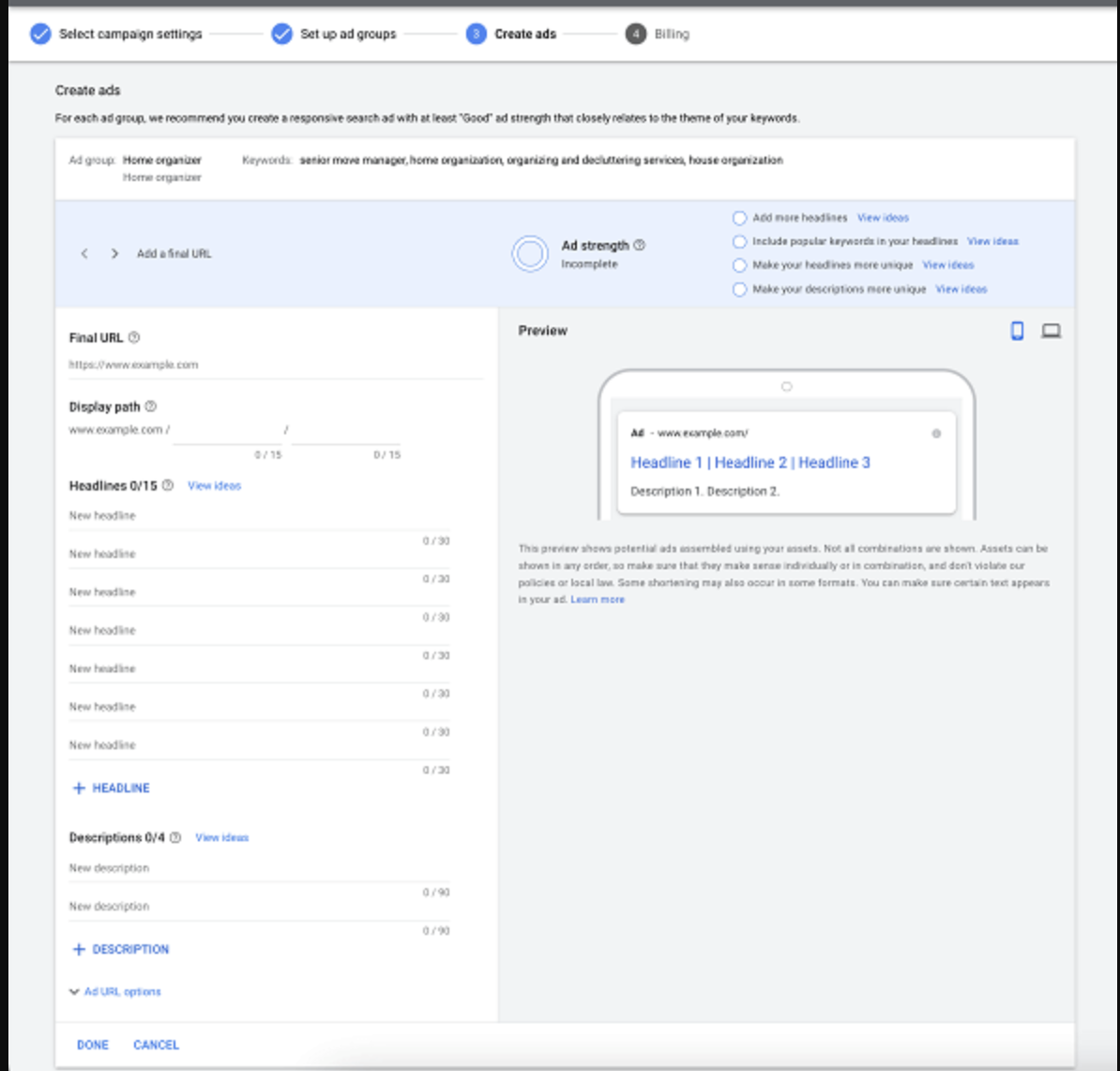
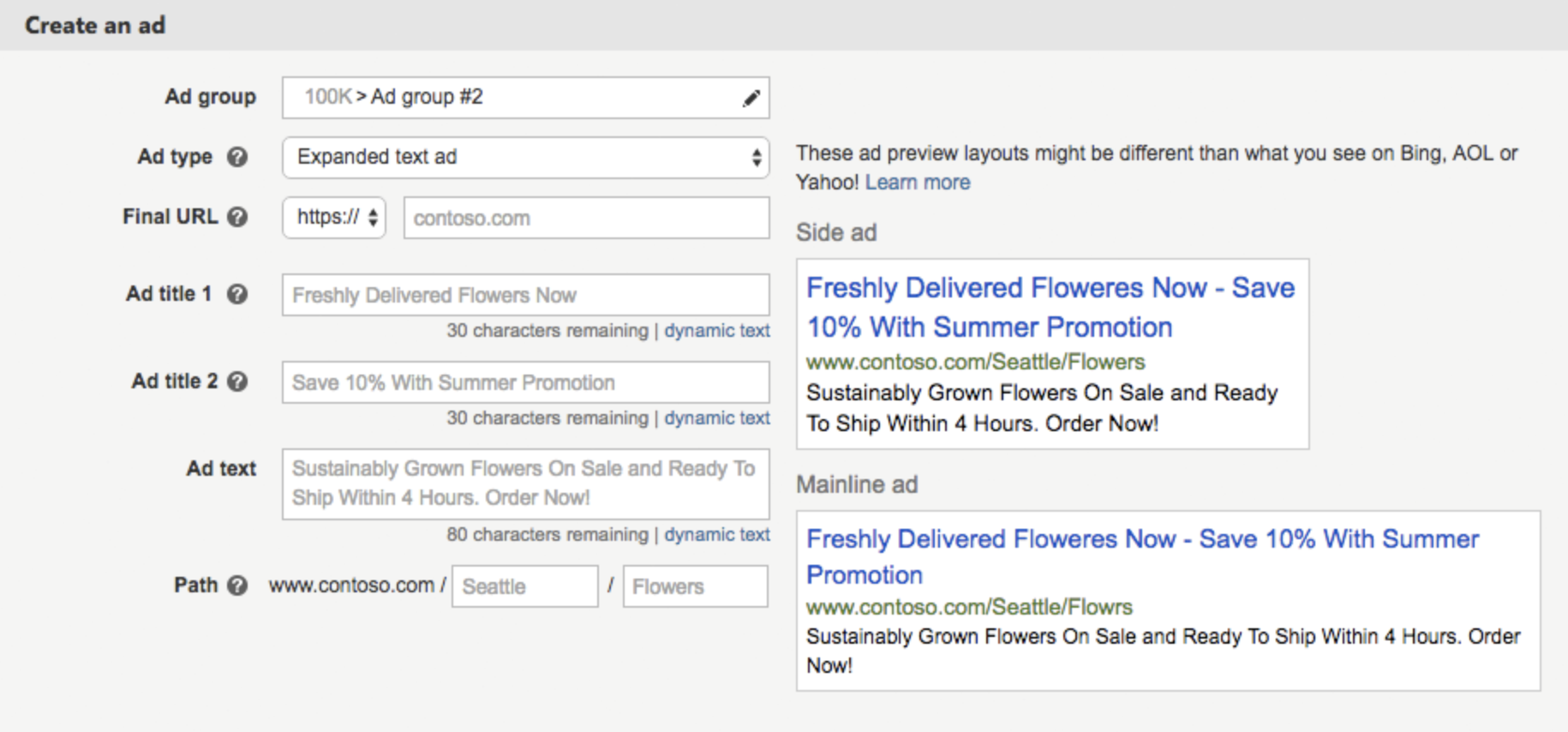
Interface Inspiration To ensure an intuitive transition for the core team, I drew inspiration from existing search engine UIs like Google Ads and Bing. By leveraging these familiar mental models, I reduced the learning curve and allowed the team to focus on strategy rather than navigating a new, unfamiliar interface.
Final Designs &
Iterations
Final Design
The interface was built for familiarity, mimicking the logic of existing search engine tools to ensure a flat learning curve. To achieve maximum flexibility at scale, I introduced a template-led system that works across all 12 languages. This ensures the design remains robust and intuitive; even if a key team member is absent, the rest of the department can step in and relaunch ads without friction.
The layout features a persistent navigation panel on the left, with file upload status and success rates on the right. From the nav panel, users manage template settings like language and account data, while the main workspace allows for the bulk editing of ad copy. When editing a template, I utilised a focused modal view with a darkened background, allowing users to drill down and edit data cell-by-cell without losing their place in the wider workflow.
Prototype Testing & Iterations Initial user testing triggered immediate refinements to streamline the workflow. I replaced tedious cell-by-cell entry with a "bulk-paste" feature for headlines and descriptions, drastically reducing manual effort. To tackle the persistent issue of trademark disapprovals, I introduced a cascading alternative system. This automatically swaps out brand-specific variables for generic, compliant copy if a trademark is flagged, ensuring ads remain live while strictly adhering to search engine rules.
The Evolution Over time, the tool evolved into a central Template Library, allowing a single language update to sync across multiple accounts simultaneously. I also implemented a "weekly re-run" feature to ensure 100% brand coverage and automated the deployment of variations for A/B testing, transforming the tool into a robust control centre for global ad management.
Conclusion
The Impact: I spearheaded the transition from a manual, Excel-heavy workflow to a unified global strategy within a single interface. By automating these processes, I saved each team member 80% of their operational time, allowing the department to pivot from manual execution to high-level strategy.
Results by the Numbers:
Performance: Tailored ad copy drove a 30% improvement in Quality Score and a significant boost in CTR.
Revenue: Delivering scalable, approved ads for every designer resulted in a 20% increase in revenue.
Scalability: The tool’s success led to its adoption by SEO and Paid Social teams, becoming the blueprint for cross-channel ad copy and translations.
Reflection
Bridging the Gap This was my first experience balancing product management with UX and marketing. I learned that cross-functional collaboration with remote engineers requires a shared language. I initially assumed certain workflows were universal, but I soon realised that technical and marketing teams view the same problems through different lenses. This taught me that clarity isn't about "common sense"—it’s about proactive alignment and building a bridge between different areas of expertise.
What I Would Do Differently The biggest lesson was the value of earlier user testing. I learned that what feels intuitive when you're "in the weeds" of design isn't always clear to a fresh pair of eyes. Moving forward, I would involve team members in the iteration cycle much sooner. I also discovered that even the most detailed documentation cannot replace direct conversation; I now prioritise regular check-ins to ensure alignment as requirements evolve, rather than relying solely on a handover file.
Have questions about my process or just want to chat about the design? I’d love to hear your thoughts. Get in touch.